


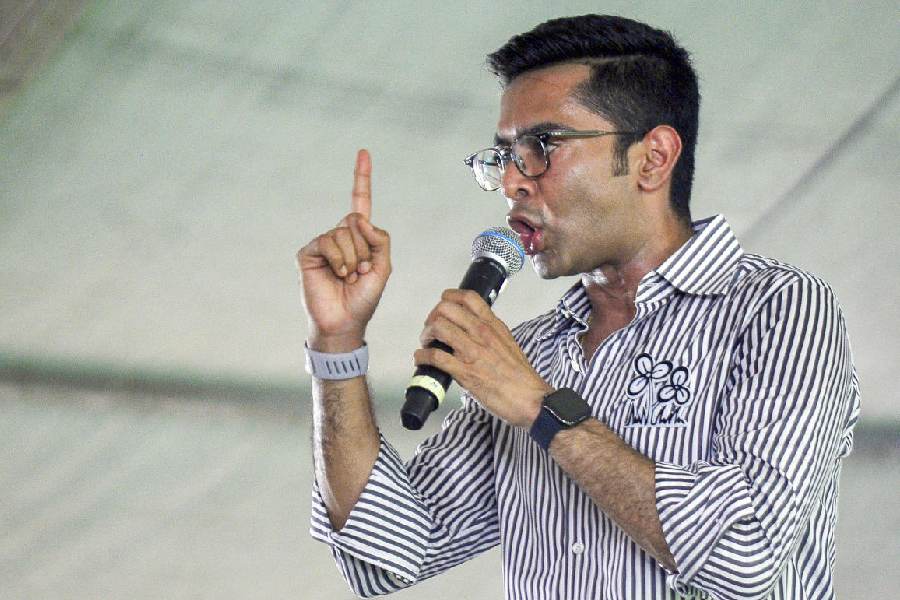
Abhishek Banerjee Politics comes under scrutiny after TMC blamed BJP over alleged post-poll violence involving Swapna Barman. Qalam Times editorial examines political hypocrisy, accountability and Bengal’s growing culture of fear.
Abhishek Banerjee Politics: TMC’s Culture of Victimhood Cannot Hide Bengal’s Collapse
Qalam Times News Network | Editorial
West Bengal has witnessed political violence for decades, but what has become increasingly disturbing is the calculated attempt by All India Trinamool Congress leaders to weaponise every tragedy for political optics while refusing to confront the deeper culture of intimidation that has flourished under their own rule.
The latest controversy surrounding athlete-turned-politician Swapna Barman is a classic example of how the Trinamool Congress leadership, especially Abhishek Banerjee, prefers emotional slogans and social media outrage over facts, institutional accountability and moral consistency.
Swapna Barman’s allegations regarding threats and the alleged torching of a structure near her residence are serious and deserve an impartial investigation. Any attack, intimidation or threat against a citizen—particularly against a woman and a national athlete—must be condemned unequivocally. But what deserves equal scrutiny is the political opportunism with which the TMC leadership immediately attempted to convert the incident into a national propaganda campaign against the BJP without waiting for verified findings.
Abhishek Banerjee Politics thrives on outrage, not accountability
Within hours of the allegations surfacing, Abhishek Banerjee took to social media declaring that “BJP goons” were responsible. He portrayed the incident as proof of democratic collapse in India and accused the BJP of fostering a politics of fear.
But Bengal’s people have a right to ask a simple question: who has governed the state for the last several years?
If political workers are allegedly unsafe, if violence has become routine, if homes are being attacked and if fear dominates rural districts, then responsibility cannot magically disappear from the shoulders of the ruling establishment. The Trinamool Congress cannot continue behaving like an opposition party while simultaneously controlling the state administration, district machinery and police structure.
This contradiction sits at the centre of modern Abhishek Banerjee Politics. Every incident is framed as a conspiracy by opponents, while the systemic failures of governance are ignored. Violence becomes selective depending on political convenience. Sympathy becomes a campaign strategy. Accountability becomes somebody else’s responsibility.
TMC’s selective outrage weakens its own credibility
For years, opposition parties in Bengal have alleged post-poll violence, intimidation and politically motivated attacks. Many of those complaints were dismissed by TMC leaders as “exaggeration” or “politically motivated narratives.” Yet after the recent electoral setback suffered by the Trinamool Congress, the party has suddenly rediscovered the language of victimhood.
Fact-finding teams are now being sent to districts. Leaders are speaking of terror, displacement and fear. The same vocabulary that the opposition used for years is now being deployed by the ruling party itself.
This political hypocrisy is impossible to ignore.
If violence is wrong today, it was wrong earlier too. If displaced families deserve justice now, they deserved justice when victims belonged to rival political camps as well. A democracy cannot function on selective morality.
Swapna Barman deserved dignity, not political exploitation

Swapna Barman earned national respect long before entering politics. Her Asian Games gold medal was a moment of pride for India. Unfortunately, instead of protecting that dignity, political parties turned her into a symbol for partisan warfare.
After joining the TMC and losing the election, she publicly expressed regret about entering politics. That statement itself reflects the toxic environment Bengal’s political culture has created. Instead of nurturing respected public figures, parties drag them into aggressive political battles and abandon them once electoral utility fades.
What is more troubling is the speed with which the TMC leadership transformed her emotional distress into a weapon against the BJP. Serious allegations require evidence, forensic investigation and legal procedure—not instant political verdicts delivered through social media posts.
Abhishek Banerjee Politics and the politics of perpetual blame
The larger issue is not one isolated incident. The larger issue is the political ecosystem that the Trinamool Congress itself helped normalise over the years. Bengal’s public discourse has become deeply polarised, emotionally charged and permanently confrontational.
Under Mamata Banerjee and Abhishek Banerjee, the TMC has mastered the art of narrative management. Every criticism is projected as an attack on Bengal. Every allegation against the government becomes “politically motivated.” Every law-and-order failure is blamed on the opposition or the Centre.
But governance cannot survive forever on emotional mobilisation.
The Calcutta High Court’s recent observations regarding the maintenance of law and order should have served as a wake-up call. Instead, the political establishment continues prioritising media battles over institutional reform.
Bengal needs political healing, not endless propaganda
West Bengal does not need another cycle of accusation and counter-accusation. It needs political maturity. It needs a ruling party capable of introspection. It needs leaders who can condemn violence consistently, regardless of party affiliation.
The tragedy is that ordinary workers, local residents and even celebrated personalities like Swapna Barman are becoming casualties of a political culture that rewards outrage more than responsibility.
The people of Bengal deserve better than fear-driven politics wrapped in emotional slogans.
And until the Trinamool Congress accepts its own role in shaping this climate, every speech about democracy and justice will continue to sound less like moral conviction and more like political performance.