


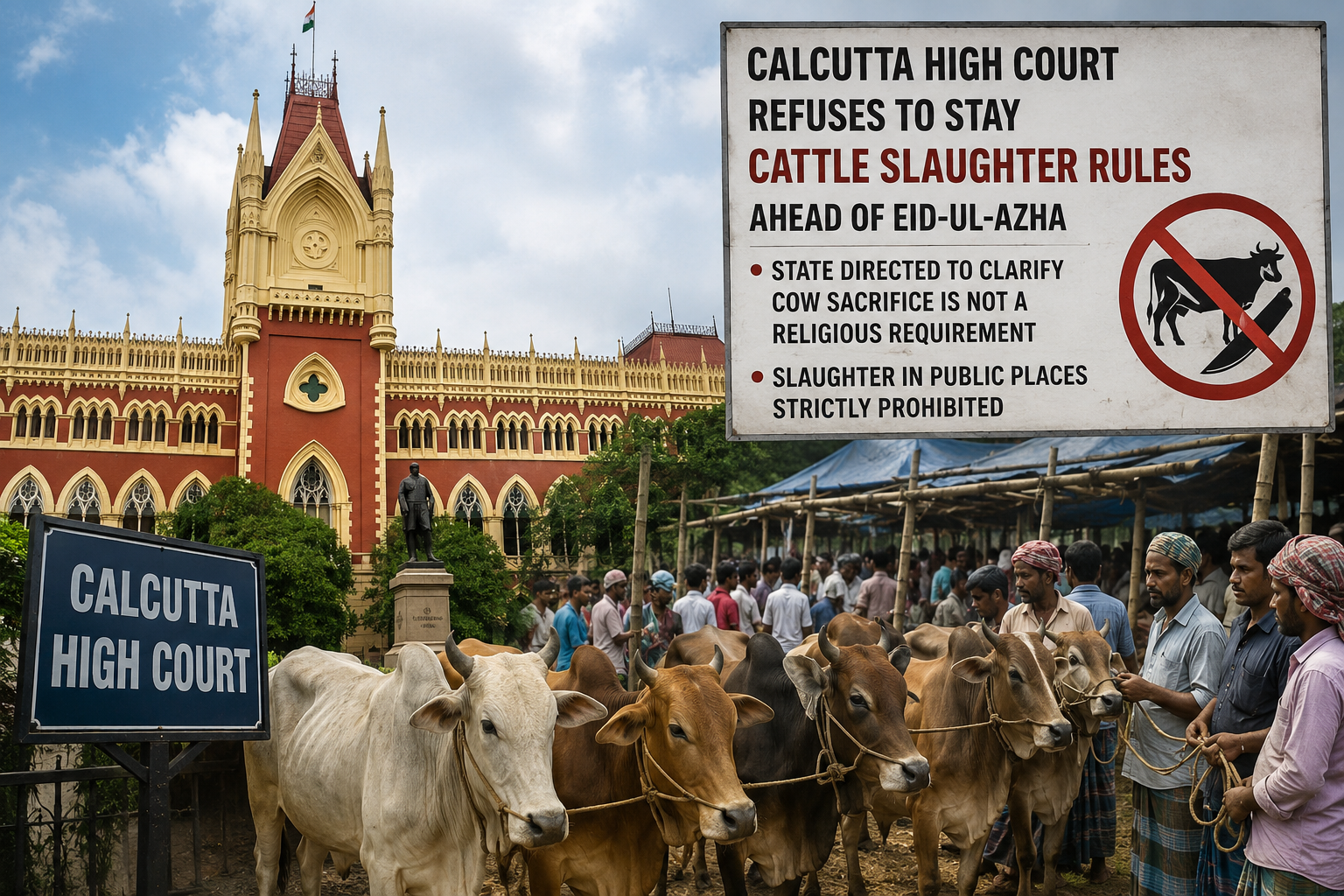
Cattle Slaughter Rules in West Bengal spark legal and political controversy ahead of Eid as Calcutta High Court refuses stay, directs government to clarify public sacrifice restrictions and possible festival exemptions.
Qalam Times News Network
Kolkata | May 21, 2026
Cattle Slaughter Rules introduced by the West Bengal government ahead of Eid-ul-Azha have sparked intense legal, political, and economic debate across the state. On Thursday, the Calcutta High Court refused to suspend the state’s recent notification regulating cattle slaughter, observing that the order was merely enforcing earlier judicial directions issued in 2018. However, the Court simultaneously directed the government to clearly state that animal slaughter in open public places is prohibited and reiterated that cow sacrifice is not an essential religious practice under Islam.

The Division Bench comprising Chief Justice Sujoy Paul and Justice Partha Sarathi Sen heard multiple Public Interest Litigations (PILs) and writ petitions challenging the state’s enforcement of the West Bengal Animal Slaughter Control Act, 1950, ahead of Bakrid. The notification issued on May 13 mandates that slaughter of bulls, bullocks, cows, calves, and buffaloes can only take place after obtaining a “fit for slaughter” certificate from competent authorities. According to the rules, only animals above 14 years of age or those permanently incapacitated due to deformity, injury, illness, or age can be approved for slaughter.
High Court Refers to Supreme Court Judgment
During the hearing, the High Court directed the state to amend its notification and explicitly include the Supreme Court’s observation in the landmark Hanif Quershi vs State of Bihar judgment. The Court emphasized that sacrifice of cows during Eid-ul-Azha is not a compulsory religious requirement in Islam. It further ordered that slaughter of animals in public spaces must remain strictly prohibited.
Livestock Farmers Claim Severe Economic Crisis
The Cattle Slaughter Rules have also triggered widespread concern among livestock farmers, traders, and rural communities across West Bengal. Several petitioners informed the Court that cattle markets throughout the state have effectively shut down following the government notification, creating a serious financial crisis for thousands of families dependent on animal trade and dairy farming.
Farmers alleged that obtaining slaughter certificates has become nearly impossible because many panchayat offices are not functioning properly after recent local elections, while several municipalities lack veterinary officers required to certify the animals. Without these approvals, legal cattle trading has reportedly come to a standstill.
Multiple Petitions Filed Against the Notification
Several families from the Ghosh community in Bhangar, South 24 Parganas district, have challenged the notification before the High Court. A separate PIL was also filed by CPI(ML) Liberation, accusing the state government of attempting to impose restrictions that threaten both religious practices and the livelihoods of people involved in livestock farming and trade. Petitioners argued that the sudden enforcement of an outdated legal framework has disrupted cattle markets, meat supply chains, Eid sacrifices, leather industries, and transport networks across the state.
Dairy Farmers’ Associations Raise Alarm
The West Bengal Dairy Farmers’ Association sharply criticized the government’s move, alleging that the notification has fueled fear and uncertainty among cattle owners and traders. According to the association, farmers traditionally sell unproductive cattle before Eid to repay loans and sustain their households. With markets now closed and transport disrupted, many farmers are facing mounting debts and pressure from buyers demanding refunds for advance payments already made for cattle purchases.
The association also warned that restrictions on cattle slaughter could impact the leather industry by reducing the supply of raw hides, potentially affecting thousands of workers connected to the sector.
State Asked to Decide on Eid ul Azha Exception
Although the High Court declined to stay the notification, it directed the West Bengal government to clarify whether any relaxation or exemption under the 1950 Act would be permitted during the upcoming Eid-ul-Azha celebrations scheduled for May 27 and 28. The matter is expected to remain under close judicial scrutiny in the coming days.