
Rohith Act demand grows as AISA protests Supreme Court stay on UGC equity rules, calling it a blow to caste justice in universities.
Qalam Times News Network
New Delhi | February 2, 2026
Rohith Act : Students, teachers, and activists say the stay weakens the fight against caste bias in universities
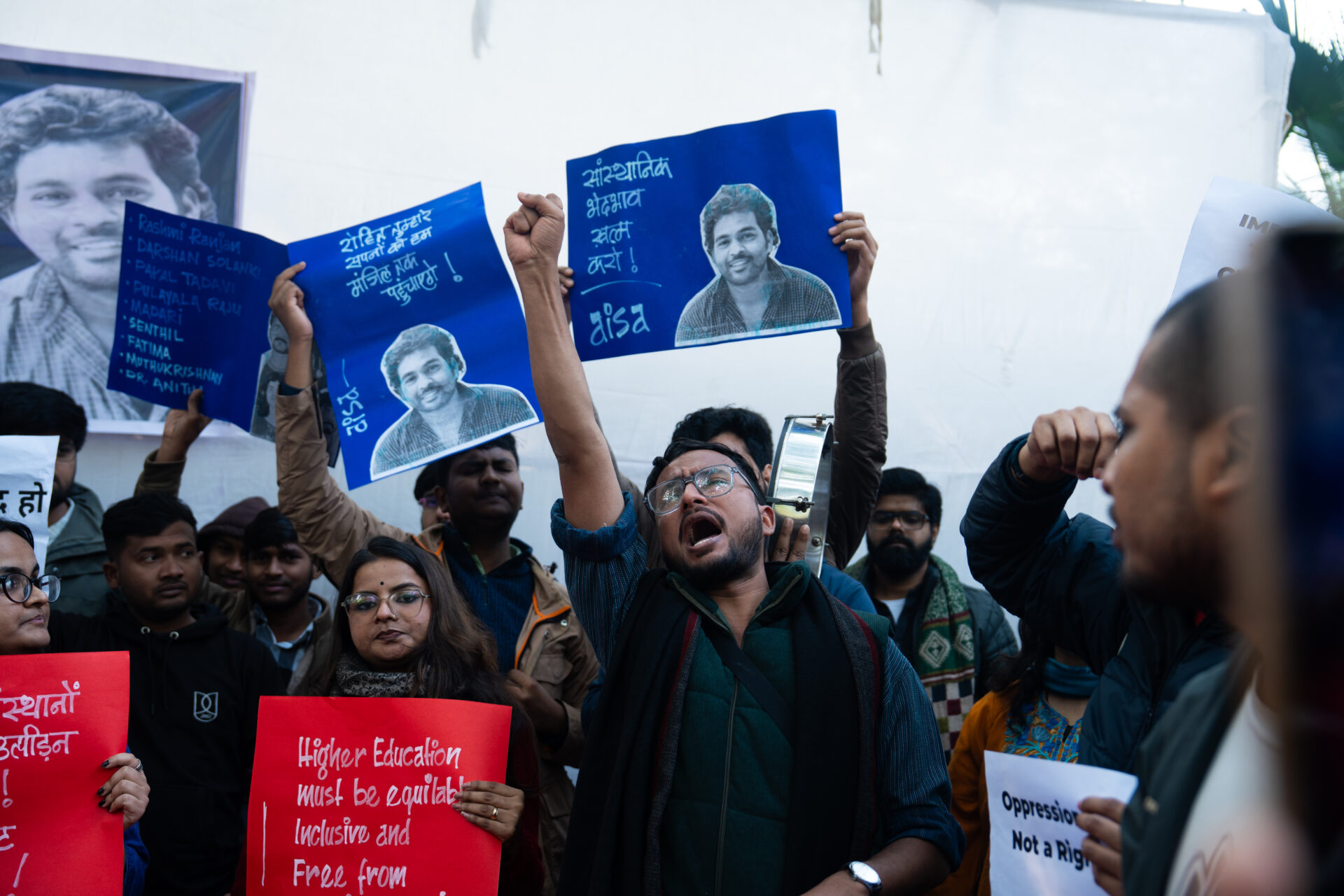
Rohith Act became the central rallying cry at Jantar Mantar on Sunday as the All India Students’ Association (AISA) led a large protest against the Supreme Court’s decision to pause the implementation of the UGC’s new equity regulations. Protesters said the stay has stalled a long-overdue institutional acknowledgment of caste-based discrimination in higher education and renewed the urgency for a statutory law to protect marginalised students.
The demonstration followed Thursday’s order by the Supreme Court of India, which temporarily halted the University Grants Commission’s Promotion of Equity in Higher Education Institutions Regulations, 2026. The court observed that the rules appeared “too sweeping” and required detailed judicial examination. However, student groups and faculty members argued that stopping the framework before it could even be implemented reflected deep resistance to confronting caste realities on campuses. In the second phase of the protest, speakers repeatedly stressed that only a Rohith Act with statutory backing could ensure accountability.
“A setback to decades of struggle”
The protest saw participation from students, university teachers, social activists, and political representatives, all of whom described the court’s intervention as a serious setback. While many acknowledged that the regulations themselves had limitations, they argued that the stay undermined years of struggle that forced institutions to admit the existence of caste discrimination.
Slogans such as “Casteism will not be tolerated” and “Down with Brahminism” echoed through Jantar Mantar, as protesters framed the gathering as part of a broader fight for social justice, dignity, and institutional responsibility.
Speakers question the logic of the stay
Addressing the crowd, CPI(ML) Liberation MP Sudhama Prasad urged students to continue organising while strengthening their academic presence. “Study well, build representation, and we will fight to secure what is rightfully yours,” he said.
Delhi University faculty members, including Dr. N. Sukumar, Dr. Jitendra Meena, Dr. Uma Gupta, and former faculty member Dr. Laxman Yadav, highlighted how discrimination in universities has persisted despite multiple committees and inquiries over the years.
Professor Nandita Narain, former president of the Delhi University Teachers’ Association, said young people were being misled into believing the regulations would divide society or harm merit. “Rohith Vemula’s death in 2016 was not an isolated event. It was the result of long-simmering institutional hostility,” she said, explaining why the demand for a Rohith Act emerged.
Background: from PIL to stalled regulations
Pressure for reform increased after Rohith Vemula’s mother, Radhika Vemula, along with Abeda Salim Tadvi, filed a Public Interest Litigation in 2019 seeking stronger enforcement of anti-discrimination mechanisms in higher education. The petition called for effective implementation of the UGC’s 2012 equity regulations and the creation of functional Equal Opportunity Cells.
The prolonged hearings in the case eventually pushed the UGC to draft updated regulations in 2025–26. These were reviewed by a Parliamentary Standing Committee, which recommended broader coverage, including Other Backward Classes. Protesters pointed out that these deliberations made the sudden stay even more troubling.
“Stopped before it even existed”
Dr. Jitendra Meena said the most disturbing aspect was that the regulation was halted before it could operate. “Something that had not even taken effect was stopped on the assumption that it might be misused,” he said. “Marginalised communities hoped, despite everything, that justice would finally be delivered. That hope has been crushed again.”
He questioned why similar preventive action is rarely taken when laws are misused against vulnerable groups, citing instances of unchecked state power elsewhere.
Regulation inadequate, but recognition mattered
Social activist Rajendra Pal Gautam said protesters were never satisfied with the regulation itself. “It was inadequate from every angle. Our demand has always been the Rohith Act,” he said, noting that several premier institutions such as IITs and IIMs were not even covered under the UGC framework.
He added that arguments about “misuse” were selective. “Every law can be misused. Does that mean we scrap all protections?” he asked, pointing to the lived realities of caste oppression across social and educational spaces.
Several speakers criticised sections of the media for framing the stay as a “victory” for upper-caste groups. Professor Uma Gupta said such coverage reflected the very mindset being challenged at the protest. “To say these rules would divide society is to pretend caste divisions do not already exist,” she remarked.
Dr. Sukumar dismissed claims that upper-caste individuals face discrimination under such measures as baseless. “If caste did not operate on campuses, there would have been no institutional deaths,” he said.
Students reaffirm demand for Rohith Act
Student leaders from AISA and Jawaharlal Nehru University said the regulation emerged from sustained nationwide struggles and was seen as a step—though an incomplete one—towards the Rohith Act. “Institutions were, for the first time, being asked to take responsibility,” said AISA president Neha. “That is precisely what frightened those in power.”
As the protest concluded, participants reiterated that caste discrimination is not created by laws that name it—but by social structures that deny its existence. For them, the stay has only strengthened the resolve to demand a comprehensive Rohith Act.