

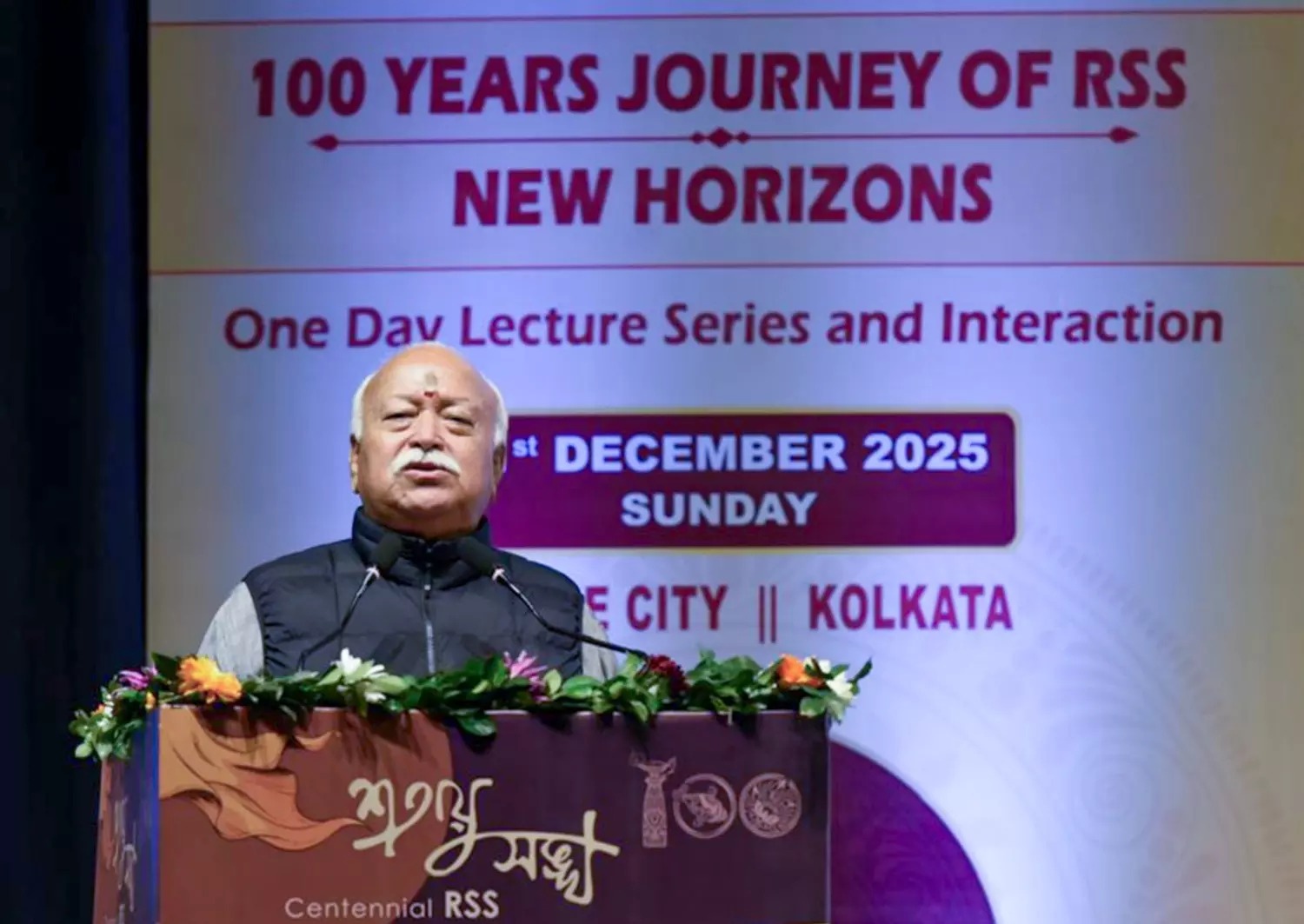
Nagpur’s ideological influence reaches Bengal as RSS chief Mohan Bhagwat challenges India’s constitutional foundations, raising concerns over democracy, pluralism, and electoral polarization.
By Qalam Times News Network
Kolkata, 25 December 2025
Nagpur :How Mohan Bhagwat’s Bengal visit strips the RSS of its “apolitical” mask
Nagpur has long been the ideological nerve center of the Rashtriya Swayamsevak Sangh, but over the past four days its shadow stretched unmistakably into West Bengal. During his visit, Mohan Bhagwat, the Sarsanghchalak of the Rashtriya Swayamsevak Sangh, delivered a series of speeches that went far beyond cultural commentary. In questioning the need for constitutional sanction to define India as a “Hindu Rashtra,” Bhagwat openly challenged the democratic and constitutional foundations of the republic. His remark—comparing the idea of India as a Hindu nation to the sunrise, needing no formal approval—was not rhetorical flourish. It was a direct assertion that ideology stands above Parliament and the Constitution.
This Nagpur-driven worldview becomes even more revealing when placed in the context of Bengal’s electoral calendar. An organization that has, since 1925, cloaked itself in the language of social and cultural reform now finds its chief urging Hindus to “unite” in order to change Bengal’s political conditions. The claim that the RSS seeks only social change collapses under scrutiny when its cadres work relentlessly in election campaigns aligned with the Bharatiya Janata Party. When religious identity is mobilized for political ends, democracy is not strengthened—it is fractured.
The most troubling aspect of Bhagwat’s intervention is his open dismissal of constitutional authority. To suggest that India’s character as a nation does not require parliamentary debate or constitutional amendment is, in effect, to undermine the legacy of B. R. Ambedkar and the document he helped craft. The Constitution is not a technical inconvenience; it is the very framework that guarantees freedom of expression—even for organizations like the RSS. Yet history raises uncomfortable questions about the Sangh’s nationalism, including its long refusal to hoist the national flag at its Nagpur headquarters for over five decades after Independence. This record lends weight to criticisms voiced by Rahul Gandhi, who has repeatedly pointed to the RSS’s controversial past, from colonial-era compromises to ideological alliances driven by political expediency.
Invoking the plight of “Bangladeshi Hindus” in Bengal is another calculated move. It seeks to manufacture fear at the local level and convert anxiety into votes. Bhagwat’s assertion that India is the only homeland for Hindus directly contradicts the pluralist ethos that has defined the subcontinent for centuries. This is a worldview that treats diversity as a threat rather than a strength. As the RSS marks its centenary, it is no longer content to operate behind the scenes; it is stepping forward, intent on reshaping power openly.
The reality is that the BJP can no longer rely solely on the charisma of Narendra Modi to break Bengal’s political resistance. That is why Nagpur’s commander-in-chief has entered the arena himself. But Bengal’s soil has produced figures like Subhas Chandra Bose, Kazi Nazrul Islam, and Rabindranath Tagore—voices that rejected division and authoritarianism in all its forms. The dream of a centralized Hindu Rashtra threatens India’s federal structure by sidelining Parliament and imposing a singular ideology. The moment demands vigilance. If this ideological overreach goes unchallenged, political authoritarianism disguised as “social change” may soon consume far more than Bengal alone.