
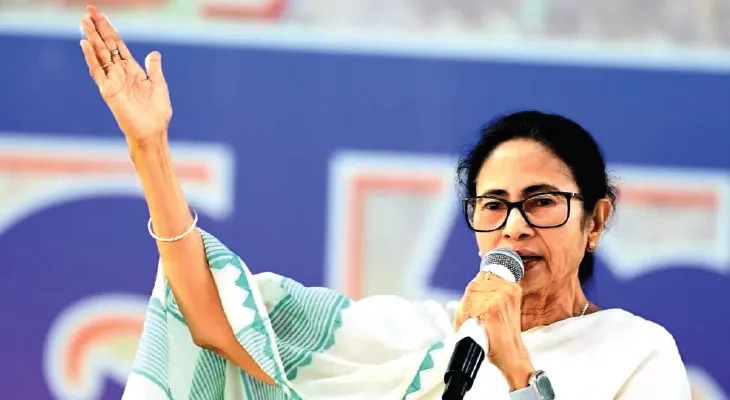
Mamata Banerjee’s decisive one-month resurgence reshapes Bengal politics, challenges BJP dominance, and strengthens grassroots support ahead of Assembly elections.
Mamata : From administrative power to street resistance, a leader reclaims her fiercest form
Dr. Mohammad Farooque
Qalam Times News Network
Kolkata | February 9, 2026
Mamata Banerjee knows how to bend political time. Between January 8 and February 8—just one month before a decisive Assembly election window—Bengal witnessed a striking transformation. In this short but decisive period, public sentiment shifted, political equations changed, and Bengal saw a familiar yet renewed version of its most dominant leader. What emerged was not merely a Chief Minister defending her office, but a battle-hardened street fighter reclaiming her natural terrain.
For fifteen years in power, Mamata Banerjee’s edge never dulled. But over the past month, her resistance outside Raj Bhavan in Delhi—standing firm against Delhi Police—rekindled memories of Singur, Nandigram, Netai, and Chhankaitala. That unmistakable fire returned, now directed against the BJP’s ambition to conquer Bengal. Mamata Banerjee, once again, positioned herself as the last standing barrier between Bengal and ideological takeover.
Her critics—those who mock her paintings, her poetry, her songs, her imperfect English—have found their weapons blunted. Over the past month, those attacks have collapsed under the weight of political reality. Their confusion mirrors the disorder of the Union Budget presented by Nirmala Sitharaman: directionless and detached. Even after crossing half a century in public life, Mamata’s political magnetism remains intact. She alone possesses the rare ability to turn governance into opposition in a single moment.
That energy has electrified the Trinamool Congress. Ministers, MPs, MLAs, councillors—everyone senses momentum. The ED raid on January 8 was merely the trailer. Her restrained yet forceful arguments before the Supreme Court, culminating in the plea—“Please Sir, save democracy”—struck a deep chord across the country. Calm voice, sharp intent, public trust restored.
Before the Special Intensive Revision (SIR) process began, BJP warnings had rattled many at the grassroots level of the ruling party. Anxiety crept in. That evaporated the moment Mamata stood before the Chief Justice, framing Bengal’s struggle as a constitutional battle for democracy itself. Only she can shake an organisation awake like this. Only she can take the fight directly into the enemy’s camp. It is now evident that nationally, she remains the BJP’s single most formidable opponent. As long as she stands, eastern India remains unconquered.
At the same time, her stance is drawing additional anti-BJP votes, even from progressive voters otherwise critical of Trinamool. The fallout? Electoral bleeding for the CPI(M) and Congress. Mamata Banerjee is simultaneously seeking a fourth mandate while shedding the comfort of incumbency, stepping back into her original role—an uncompromising protest leader. Wrapped in a simple sari outside Raj Bhavan, she sent a clear message: resistance flows in her bloodstream.
Whether at the ED office in Salt Lake, on Delhi streets, before Raj Bhavan, or inside the Supreme Court courtroom of Chief Justice Surya Kant—she has proven repeatedly that whenever Bengal or Bengalis are challenged, her presence at the frontlines is inevitable. Like the sun and moon, there is no parallel challenger. That has always been her greatest strength. Strike once, and she responds with multiplied force, defying even Newton’s laws. Scholars fluent in polished English or masters of fine art still fail to decode this instinct. Many retreat mid-battle, later dismissing her as “theatrical” out of sheer frustration.
Beyond symbolism, governance continues. Whether through SIR resistance or people-centric budgetary announcements, her focus remains fixed on working citizens. Despite continuous obstruction by the BJP-led Centre and nearly ₹2 lakh crore in withheld dues, Bengal’s development has not stalled. The recent Union Budget once again sidelined Bengal completely. Bihar, before elections last year, received ₹58,000 crore, new institutions, boards, and offices. Bengal received recycled promises—freight corridors and an unrealistic bullet train dream.
Yet within 100 hours of the Union Budget, Mamata’s interim state budget offered tangible relief. From housing and 100-day work to ASHA workers, from expanded Lakshmir Bhandar to women’s empowerment—the safety net widened. Even the harshest critics struggled to respond. Para-teachers, civic volunteers—none were ignored. The interim budget allocated ₹2,000 crore to the Mahatmasree scheme, ensuring assured income for rural workers despite central non-cooperation.
The revival of Youth Allowance (Yuvashree) for Madhyamik pass students has particularly unsettled critics. They call it “freebie economics.” But the data speaks otherwise. Nearly 1.75 lakh people have moved above the poverty line in 15 years. Social sector spending has multiplied. The state budget grew from ₹84,000 crore under the Left to nearly ₹4 lakh crore today. Unemployment has dropped by 45.67% according to central data. Per capita income has risen. GST revenue is up fivefold. Fiscal deficit reduced to 2.5% of GSDP. Infrastructure spending continues independently.
Schemes like Lakshmir Bhandar, Swasthya Sathi, Yuvashree, and Kanyashree are not charity—they are constitutional recognition of dignity. They increase purchasing power, drive demand, and sustain internal growth even in adverse times. The interim budget stands firmly on this economic foundation.
Those who stayed silent during zero-deficit theatrics of past finance ministers now question women-centric empowerment. History will judge the irony. Mamata Banerjee is doing what the Left once promised but never delivered—without apology.
Over the past month, Bengal’s poorest have identified their protector. That is why it is safe to say: the Mamata era is far from over. Last time, the slogan was “Khela Hobe.”
This time, it is “Fatafati Khela Hobe.”
The game has already begun. Only the climax remains.