


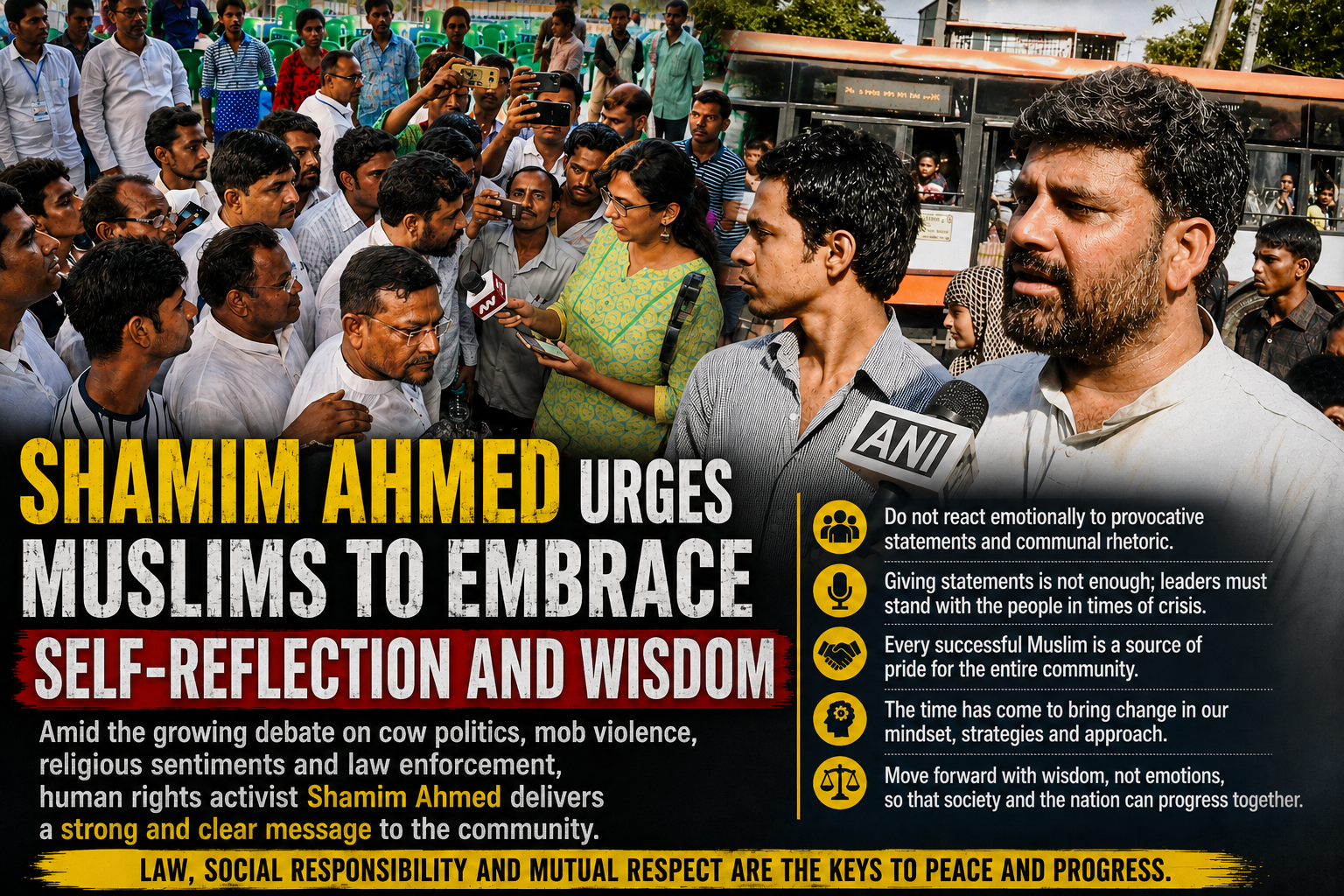
Cow Politics debate intensifies as human rights activist Shamim Ahmad urges Muslims to adopt self-reflection, respect social sensitivities, and avoid emotional reactions amid rising tensions over cow protection laws in India.
Qalam Times News Network
Kolkata | May 24, 2026
Human Rights Activist Shamim Ahmed Says Emotional Reactions and Lack of Social Responsibility Have Deepened the Crisis
Cow Politics has once again intensified the national debate around mob violence, religious sensitivities, and the enforcement of laws linked to cow protection in India. The controversy regained momentum after several religious figures demanded that the cow be declared the national animal and called for a complete ban on cow slaughter and beef exports. Amid this sensitive atmosphere, noted social activist, human rights defender, President of the Human Rights Protection Association, and Qaed-e-Urdu, Shamim Ahmed, made a bold and uncompromising statement, saying that the real problem is not only the government or the law, but also the community’s own negligence, emotional responses, and short-term thinking that have contributed to the worsening situation.
Shamim Ahmed stated that the government did not introduce these laws overnight, as they have existed for years. He questioned why outrage erupts only when authorities begin strict implementation, while the same people remain silent at other times. According to him, the issue goes beyond legislation and points directly toward public behavior and social attitudes. He criticized a section of society that, in his words, is excessively eager to prove its secular credentials by immediately offering explanations against its own community in every controversy. Referring to this behavior, he remarked that it resembles someone becoming “overly emotional at another person’s wedding,” exposing internal weaknesses before the world instead of addressing them wisely. He stressed that Cow Politics has become more dangerous because emotional reactions often replace rational thinking.
“Why Did This Realization Come So Late?”

Speaking in a sharp tone, Shamim Ahmed also questioned recent announcements by certain clerics and mosque leaders who suggested holding Friday prayers in multiple congregations to avoid offering prayers on roads. He asked why this practical wisdom had not emerged years earlier. He pointed out that there is no shortage of mosques in towns and cities, yet roads were frequently turned into prayer spaces, unnecessarily giving critics an opportunity to target the Muslim community. If separate congregations can be organized today, he asked, why was this solution ignored in the past? According to him, the changing political atmosphere has suddenly forced many people to confront realities they had long avoided.
He further criticized the silence of several religious leaders on issues that, according to him, required social sensitivity. Shamim Ahmed questioned why sermons rarely addressed concerns such as openly hanging and selling beef in crowded public areas or creating scenes that could hurt the sentiments of others. He said Islam teaches wisdom, cleanliness, discipline, and respect for the feelings of fellow citizens, but these principles were often ignored in practice. Now that stricter actions are being taken and the political balance has changed, many leaders have suddenly started talking about reforms and discipline.
“Most Leaders Only Speak, They Do Not Stand With the People”
Shamim Ahmad said the outside world assumes that the religious scholars and leaders appearing on television represent the entire Muslim community, whereas in reality many of them are limited to issuing statements. He alleged that such figures are rarely seen helping ordinary people during riots, legal troubles, or social crises, yet they remain at the forefront when it comes to creating emotional headlines and media debates. He raised a direct question: if certain practices are now being acknowledged as harmful or socially damaging, why were voices not raised against them earlier? Why were young people not guided with wisdom instead of emotional slogans?
Known for his grounded and fearless opinions, Shamim Ahmad has repeatedly spoken on sensitive matters with honesty rather than political convenience. He has consistently preferred truth, social responsibility, and practical welfare over temporary popularity or appeasement politics. This, observers say, is why his statements often receive serious attention in social circles, as he does not merely criticize but also encourages introspection within the community.
Call for Self-Accountability and Social Wisdom
In his concluding remarks, Shamim Ahmad emphasized that Muslims must begin with self-accountability instead of blaming others for every crisis. He said changing circumstances demand changes in strategy and social behavior. Mere slogans, protests, and emotional speeches, he warned, cannot secure the future of the community. According to him, it is the ordinary Muslim who suffers during every riot, controversy, or political conflict, while those delivering provocative speeches often remain protected in comfortable surroundings.
He urged Muslims to respect the law, understand social sensitivities, and avoid actions that fuel hatred or provoke tensions. He warned that the weaker sections of society always pay the highest price in communal conflicts. Those giving inflammatory speeches today, he said, may abandon the public tomorrow. Therefore, he concluded, the community must move forward with wisdom, realism, and strategic thinking rather than emotions, otherwise the situation could become even more serious in the future.