

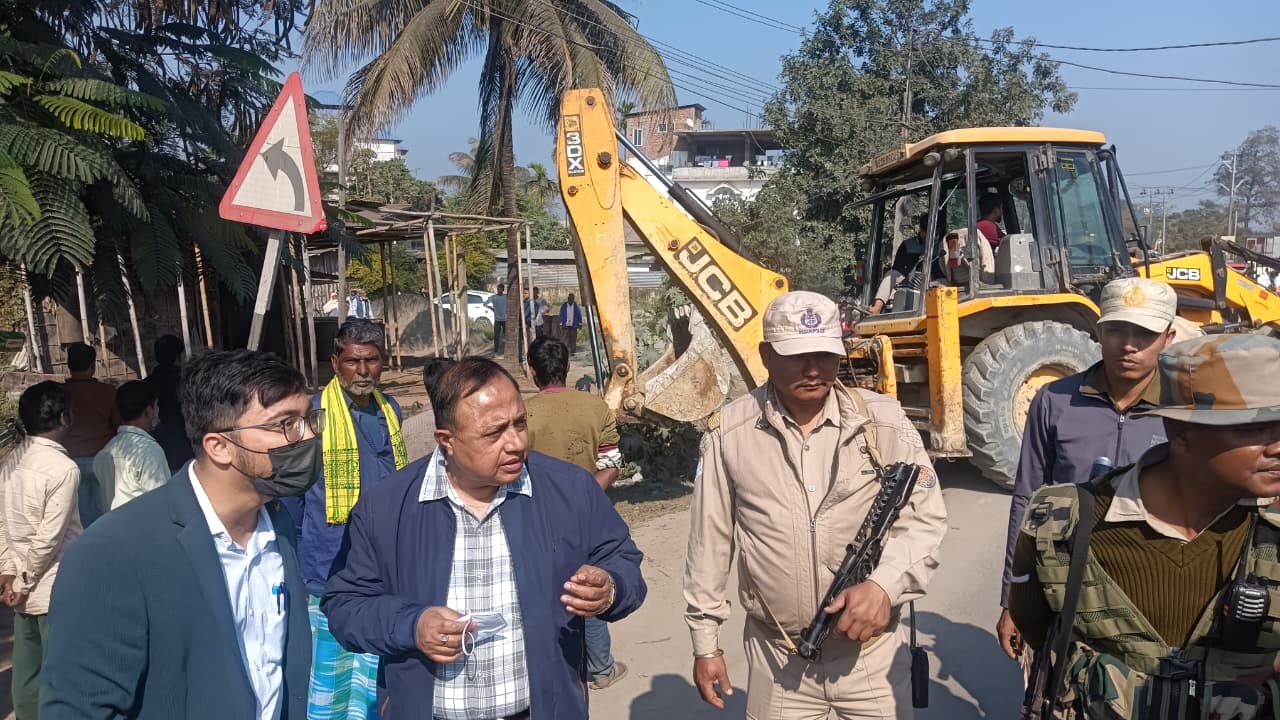
Eviction Drive in Assam’s Sonitpur district demolishes 1,200 homes of Bengali Muslims inside Burhachapori Wildlife Sanctuary, raising concerns over displacement, erosion-affected families, and rehabilitation policies.
By Qalam Times News Network
Sonitpur, Assam | January 7, 2026
Eviction Drive : Forest clearance operation inside Burhachapori Wildlife Sanctuary sparks renewed debate over displacement and rights

Eviction Drive operations carried out by the Assam administration over January 5 and 6 resulted in the demolition of nearly 1,200 homes belonging to Bengali Muslim families in Sonitpur district, triggering fresh concerns over large-scale displacement in the state. The action was undertaken to remove what officials described as illegal settlements spread across approximately 650 hectares of land within the Burhachapori Wildlife Sanctuary.
The eviction drive was conducted across multiple villages falling under the Tezpur Sadar and Dhekiajuli revenue circles. Affected areas included Jamuktol, Arimari, Siyalichar, Baghetapu, Galatidubi, Lathimari, Kundulichar, Purba Dubramari, and Batulichar. According to officials quoted by the Press Trust of India (PTI), the families had constructed houses and were cultivating crops inside protected forest land.
Authorities said the latest operation followed a major clearance exercise carried out in February last year, when more than 2,000 hectares of land in and around the sanctuary were cleared in one of Assam’s largest such actions. Since the Bharatiya Janata Party assumed power in the state in 2016, similar drives have been carried out across several districts, with a significant number of them impacting Bengali-speaking Muslim communities.
Chief Minister Himanta Biswa Sarma stated earlier this week that the government has reclaimed close to 1.5 lakh bighas of land through these eviction operations. However, many of those displaced argue that their families had lived in the region for decades. Several residents claimed their ancestors had settled in these areas after losing farmland to continuous erosion caused by the Brahmaputra River.
A previous report highlighted that river erosion has wiped out hundreds of villages over the past four decades, leaving thousands landless and forcing families to migrate repeatedly in search of survival. Displaced residents say these historical realities are often ignored during eviction proceedings.

Despite appeals from residents requesting a delay due to harsh winter conditions, the administration proceeded with the demolitions. Sonitpur District Commissioner Ananda Kumar Das was quoted as saying that the administration could not make exceptions, as the settlements were located within forest land and therefore considered illegal.
Past eviction drives in Assam have also witnessed violent clashes. In July last year, a confrontation in the Krishnai area of Goalpara district turned deadly when police firing killed a 19-year-old Muslim youth and injured several others, including police personnel, during an attempt to relocate evicted families.
The latest eviction drive has once again brought the issue of conservation versus humanitarian concerns to the forefront, raising questions about rehabilitation, accountability, and the long-term impact of such actions on already vulnerable communities.