



Satta Market in India explained: from Phalodi’s election predictions to Mumbai’s hubs and crypto platforms handling ₹25,000 crore in wagers.
Qalam Times News Network
Kolkata, May 3, 2026
From Phalodi’s traditional networks to crypto-driven platforms, how India’s underground satta market is evolving and influencing elections
Satta Market activity across India has surged sharply following recent assembly elections, drawing attention not just to traditional satta hubs but also to a rapidly expanding digital wagering ecosystem. Rajasthan’s Phalodi market has once again made headlines with predictions hinting at a possible political shift in West Bengal, but a bigger question is emerging—how large and influential has India’s satta network actually become?
Phalodi, a town in Rajasthan, has built its reputation over decades as a trusted center for political satta. Unlike modern systems, it operates on human intelligence rather than algorithms. Its origins trace back to the 19th century, when locals placed wagers on rainfall and crop outcomes. Over time, this evolved into election forecasting. Even today, bookmakers rely on a deeply rooted network of informants across states like Uttar Pradesh, Bihar, and West Bengal, gathering insights on caste equations, voter mood, and ground-level political trends. This Satta Market thrives on coded communication, verbal deals, and long-standing trust rather than digital tools.
The Shift: Digital Platforms and Crypto-Based Satta
While traditional satta bazaars continue to operate, the real transformation is happening online. Illegal offshore platforms such as Polymarket are reportedly handling massive volumes of election-related wagers. According to estimates, over ₹25,000 crore has already been staked across states like Tamil Nadu, West Bengal, Kerala, Assam, and Puducherry.
These platforms function more like financial exchanges, where users trade positions on election outcomes rather than simply placing bets. Accessed through VPNs and crypto wallets, they allow Indian users to bypass legal restrictions. The appeal is simple—real money is involved, and participants believe this leads to sharper, more informed predictions compared to traditional exit polls.
Mumbai and Delhi: The Tech-Driven Satta Hubs
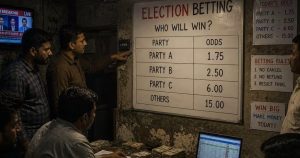
Cities like Mumbai and Delhi represent a different layer of the satta ecosystem. Mumbai, historically associated with Matka gambling, has now become a major center for cricket satta and online wagering platforms. These urban markets are heavily tech-driven and often connected to international networks.
Here, wagers align with global odds, digital payments dominate, and transactions happen instantly. Compared to Phalodi’s traditional model, these markets operate at a much larger scale and with far greater speed and reach.
Market Size and Expansion
Despite strict laws, India’s satta industry is estimated to be worth between $130 billion and $150 billion annually. A growing share of this is now digital, with states like Maharashtra, Telangana, and Karnataka emerging as major hubs.
Tamil Nadu currently appears to be one of the most active election satta markets, with rapid shifts in trends based on exit polls and political developments.
Experts warn that these prediction markets are not just reflecting public opinion—they may actively shape it. There are increasing concerns about manipulation, where false surveys or misleading information are spread to influence satta trends before insiders cash out.
Authorities have also flagged serious legal risks. Since 2025, online betting has been completely banned in India, yet users continue accessing offshore platforms through VPNs and cryptocurrencies. This raises concerns around money laundering, tax violations, and foreign financial interference in domestic elections.
There is no single answer. Phalodi dominates in terms of credibility and political forecasting legacy. Meanwhile, Mumbai and Delhi lead in scale, technology, and global integration. On the other hand, digital platforms are rapidly overtaking both, creating a parallel financial system that operates beyond borders and regulations.
What this really means is that India’s satta landscape is no longer just about local bazaars—it has evolved into a complex, multi-layered network combining tradition, technology, and global finance.