


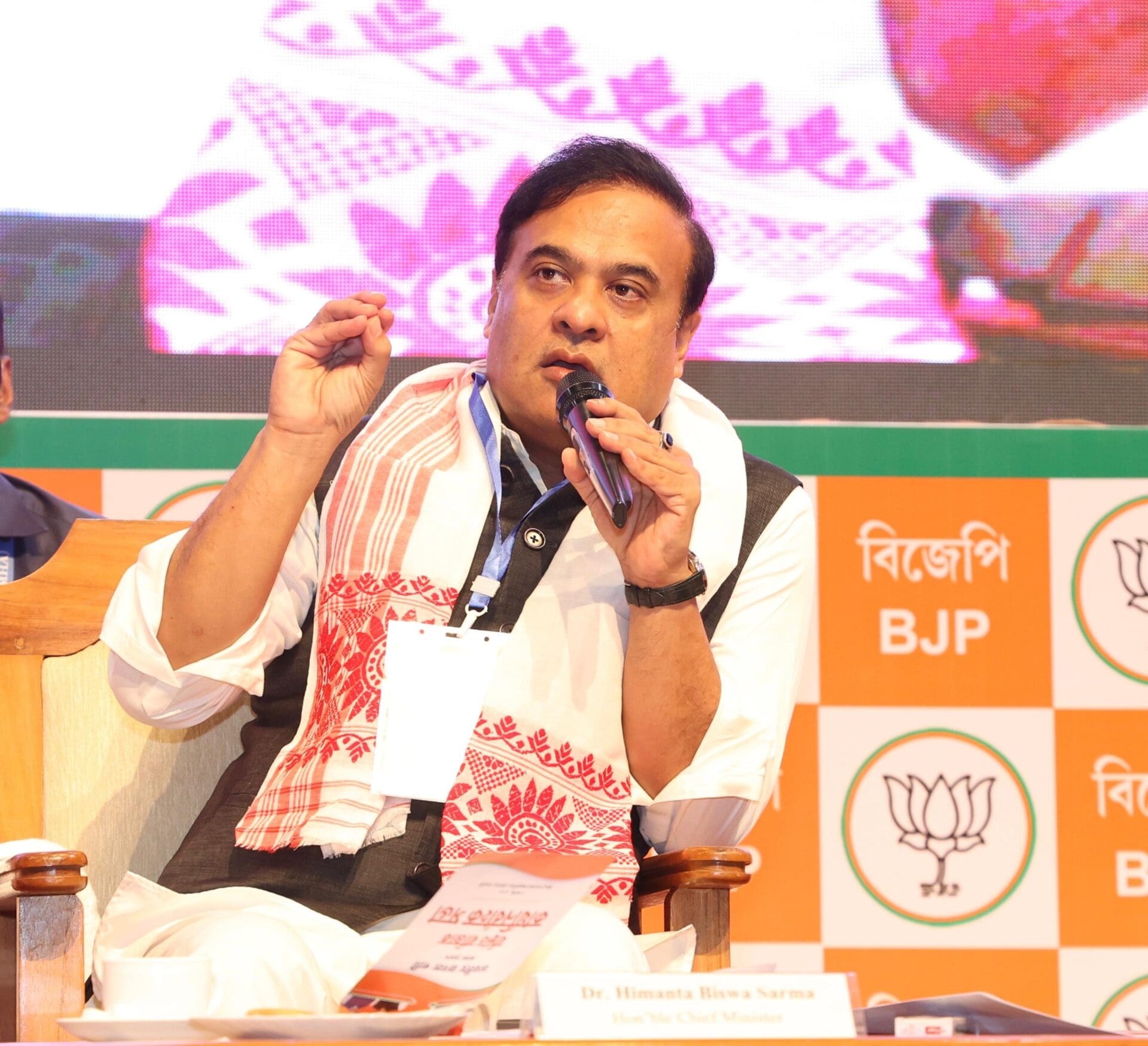
Electoral disenfranchisement controversy erupts in Assam as Chief Minister Himanta Biswa Sarma confirms Bengali-speaking Muslims exclusively targeted in voter roll revision, with 10 lakh names facing deletion before assembly elections.
By Qalam Times News Network
Guwahati | January 25, 2026
Electoral : Himanta Biswa Sarma’s controversial admission exposes systematic electoral disenfranchisement as over one million voters face deletion ahead of crucial assembly polls
The northeastern state of Assam finds itself embroiled in a constitutional crisis as electoral disenfranchisement takes center stage, following Chief Minister Himanta Biswa Sarma’s startling public admission that only Bengali-speaking Muslims—pejoratively termed “Miyas”—are receiving notices under the state’s special electoral roll revision exercise.
Speaking to reporters on Saturday, January 24, 2026, Sarma displayed remarkable candor about the discriminatory nature of the ongoing process. “There exists no controversy regarding the special revision. Has any Hindu received a notice? Has any Assamese Muslim been served? The notices have gone exclusively to Miyas and similar individuals, otherwise they would dominate us completely,” the Chief Minister declared, according to Press Trust of India reports. This brazen acknowledgment of electoral disenfranchisement has triggered fierce backlash from opposition parties and civil rights organizations nationwide.
The Mechanics of Mass Disenfranchisement
The controversy revolves around an unprecedented electoral exercise announced by the Election Commission. On December 27, 2025, the constitutional body revealed that more than one million voters had been identified for potential removal from Assam’s electoral register following a house-to-house verification campaign conducted between November 22 and December 20, 2025.
What distinguishes Assam’s revision from similar exercises undertaken in twelve other states and Union Territories is the conspicuous absence of document verification. While other jurisdictions conducted intensive revisions with stringent documentary evidence requirements, Assam’s process relied solely on physical verification without any supporting paperwork—a procedural anomaly that opposition parties contend creates opportunities for systematic manipulation.
The Election Commission, acting on its own initiative rather than responding to state requests, directed Assam’s Chief Electoral Officer on November 17, 2025, to implement this special revision. The final amended voter list carries immense significance, scheduled for publication on February 10, 2026—mere weeks before the state assembly elections anticipated for March-April 2026.
Political Calculus Behind Voter Suppression
Chief Minister Sarma has demonstrated no hesitation in articulating his administration’s intentions. “There remains nothing to conceal. We are deliberately creating difficulties for them,” he stated, referencing his previous pronouncements that Bengali Muslims would encounter substantial obstacles under his governance.
The Chief Minister elaborated on his strategy with striking openness: “They must comprehend that indigenous Assamese communities are mounting resistance against them at various levels. Without such resistance, they would advance unchecked. Consequently, some receive notices during the special revision, others face eviction proceedings, while still others encounter border police scrutiny.”
In perhaps his most revealing comment, Sarma remarked, “We shall engage in some utpaat [mischief], albeit within legal boundaries… we stand with the economically disadvantaged and marginalized, but not with those seeking to annihilate our jati [community].” This statement, though wrapped in assurances of legality, has intensified accusations that the revision constitutes politically motivated persecution masquerading as administrative procedure.
Opposition Mobilizes Legal Response
Multiple opposition parties have refused to accept this electoral manipulation passively. A coalition comprising the Indian National Congress, Raijor Dal, Communist Party of India (Marxist), Communist Party of India (Marxist-Leninist), and Assam Jatiya Parishad filed a comprehensive police complaint on January 7, 2026, accusing Bharatiya Janata Party state president and Member of Parliament Dilip Saikia of orchestrating a conspiracy to delete genuine voters’ names.
The complaint alleges that Saikia instructed BJP legislators to ensure the removal of “anti-BJP voters” across at least sixty of Assam’s 126 assembly constituencies—a claim suggesting systematic electoral engineering on an unprecedented scale.
Additional complaints emerged on January 23, 2026, when Congress official Tuleswar Rabha, who heads the Boko Block Congress Committee, alleged that BJP leaders, accompanied by local associates and office personnel, unlawfully accessed the Boko co-district commissioner’s election branch after regular working hours. According to Rabha’s complaint, these individuals attempted to breach the electoral roll revision portal using official government credentials, intending to manipulate entries through Form 7—the prescribed application for contesting voter list inclusions or requesting deletions.
Video Evidence Surfaces
Raijor Dal leader and Sivasagar legislator Akhil Gogoi separately approached law enforcement authorities in Jorhat, presenting video documentation allegedly showing four individuals “unlawfully entering and operating inside the Boko co-district commissioner’s office.” Gogoi’s complaint stated the footage captured these persons “unauthorisedly accessing” confidential documents and electronic databases.
“Consequently, substantial possibility exists for illegally adding fictitious voters’ names and deleting genuine voters’ identities without lawful authorization,” Gogoi asserted in his formal complaint, demanding immediate investigation and criminal proceedings against those identified in the video evidence.
Historical Context: Identity Politics in Assam
The current electoral controversy cannot be divorced from Assam’s turbulent history concerning migration, citizenship, and ethnic identity. The state has experienced successive waves of migration, particularly from neighboring Bangladesh (formerly East Pakistan), creating deep-seated anxieties among indigenous communities about demographic transformation and resource competition.
The recently concluded National Register of Citizens exercise, which aimed to identify undocumented immigrants, left approximately 1.9 million residents excluded from the final register published in August 2019. That contentious process deepened communal fissures and created humanitarian crises as families faced potential statelessness.
The Bharatiya Janata Party and Chief Minister Sarma have consistently characterized Bengali-speaking Muslims as “infiltrators” who allegedly usurp employment opportunities, agricultural land, and natural resources rightfully belonging to indigenous Assamese populations. This rhetoric, while politically potent among certain constituencies, has drawn widespread condemnation from human rights organizations as inflammatory and discriminatory.
Constitutional and Democratic Implications
Legal experts have expressed grave concerns regarding the constitutional validity of a voter roll revision process that its own architect admits targets a specific religious and linguistic community. The Indian Constitution guarantees equality before law and prohibits discrimination based on religion, race, caste, sex, or place of birth under Articles 14 and 15.
“When a Chief Minister publicly acknowledges that only members of one particular community are receiving deletion notices, it constitutes an admission of discriminatory state action that violates fundamental constitutional principles,” observed a senior constitutional lawyer who requested anonymity given the politically charged atmosphere.
The absence of document verification in Assam’s revision, contrasted with its mandatory inclusion in other states’ processes, raises additional questions about procedural fairness and equality of treatment—cornerstones of administrative law jurisprudence.
Electoral Commission’s Pivotal Role
The Election Commission of India, constitutionally mandated to conduct free and fair elections, finds itself at the center of this maelstrom. Critics question why the constitutional body ordered a special revision exclusively for Assam without document verification, departing from standard protocols followed elsewhere.
The Commission has maintained silence regarding the Chief Minister’s admissions and the opposition’s allegations, neither defending its procedural choices nor addressing concerns about potential misuse of the revision process for partisan advantage.
With the final voter list publication scheduled for February 10, 2026, and assembly elections imminent, the Commission’s decisions during this critical period will significantly impact not only electoral outcomes but also public confidence in India’s democratic institutions.
Communities Living in Fear
Ground reports from Bengali-speaking Muslim dominated areas across Assam paint a picture of widespread anxiety and uncertainty. Families who have resided in the state for generations now face the prospect of losing their voting rights based on verification processes they describe as arbitrary and discriminatory.
Community leaders report that deletion notices often lack specific grounds for removal, making effective contestation difficult. The February 10 deadline for finalizing the revised rolls leaves minimal time for affected individuals to mount legal challenges or administrative appeals—a timeline opposition parties characterize as deliberately compressed to prevent adequate remedy.
As Assam approaches both the voter list publication date and subsequent assembly elections, the state stands at a crossroads. The Chief Minister’s unapologetic stance, the opposition’s determined resistance, and the Election Commission’s institutional credibility all hang in the balance.
Over one million voters—predominantly from one community—await their electoral fate. Their inclusion or exclusion will not merely determine numerical voting strength but will send powerful signals about whose voices matter in Assam’s democracy, who qualifies as a legitimate stakeholder in the state’s future, and whether constitutional protections against discrimination retain practical meaning.
The unfolding drama surrounding electoral disenfranchisement in Assam transcends regional politics, raising fundamental questions about the health of Indian democracy, the protection of minority rights, and the judiciary’s role in safeguarding constitutional values when political executives openly acknowledge discriminatory practices.
As the February 10 deadline approaches, all eyes remain fixed on Assam—not merely to observe an administrative exercise, but to witness whether India’s democratic institutions possess the strength to prevent systematic disenfranchisement dressed in bureaucratic legitimacy.
—————————————————————————————————–
Qalam Times News Network is committed to independent, factual journalism that holds power accountable and amplifies marginalized voices.