
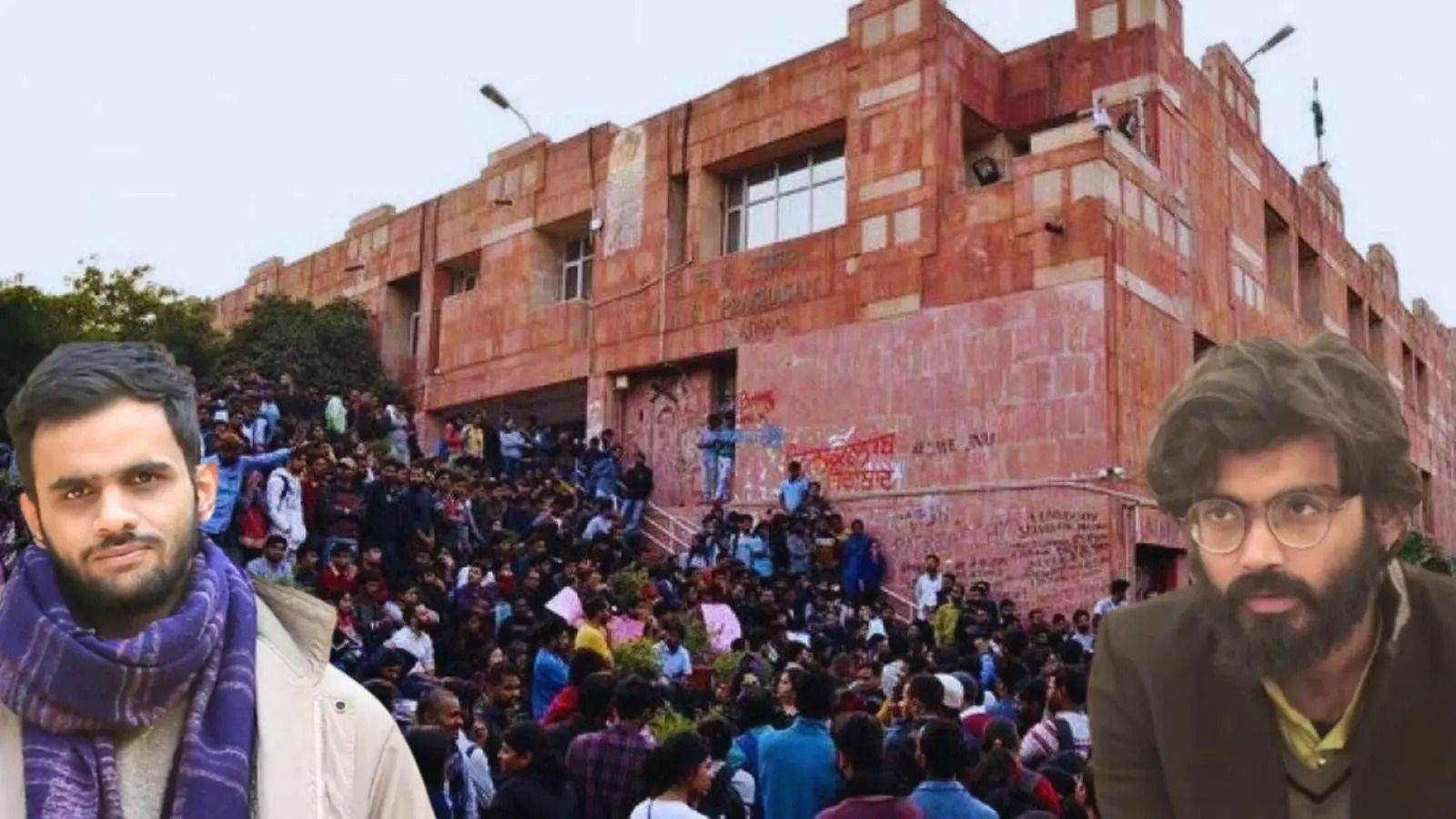
JNU Protest after the Supreme Court rejects bail for Umar Khalid and Sharjeel Imam leads to controversial slogans, an FIR request by JNU authorities, a Delhi Police probe, and sharp reactions from BJP and opposition leaders alike.
By Qalam Times News Network
New Delhi | January 6, 2026
JNU Protest : Late-night slogans at Jawaharlal Nehru University trigger FIR request, Delhi Police inquiry, and sharp reactions across the political spectrum
JNU Protest erupted late Monday night at Jawaharlal Nehru University, hours after the Supreme Court of India rejected the bail pleas of former students Umar Khalid and Sharjeel Imam in the 2020 Delhi riots case. A group of students gathered near the Sabarmati Hostel and raised controversial slogans against Prime Minister Narendra Modi and Home Minister Amit Shah, prompting a swift political backlash and police action.
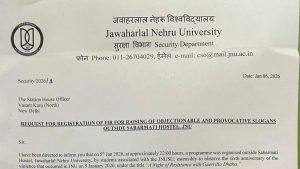
Following the incident, Delhi Police reached the campus after JNU’s Chief Security Officer formally wrote to the Vasant Kunj police station requesting the registration of an FIR. In the letter, the university administration stated that the slogans were “deliberate, provocative, and repeated,” adding that such acts violated the university’s code of conduct and posed a serious risk to campus harmony and public order. The administration also named several student leaders, including JNUSU president Aditi Mishra, as being present at the site during the JNU Protest.
Supreme Court Order and the Trigger
The protests followed a detailed Supreme Court order by a bench comprising Justices Aravind Kumar and Prasanna B. Varale, which held that the prosecution had placed sufficient material indicating a larger conspiracy involving Umar Khalid and Sharjeel Imam. The court observed that both accused stood on a “qualitatively different footing” from other co-accused and ruled that the bar under Section 43D(5) of the UAPA applied, making them ineligible for bail at this stage. While several other accused in the same case were granted bail, Khalid and Imam—who have spent over five years in jail—were directed not to file fresh bail pleas for at least one year.
Political Reactions Pour In
The incident quickly snowballed into a wider political controversy. Leaders from the Bharatiya Janata Party accused JNU of once again becoming a hub of “anti-national activities.” BJP spokesperson Shehzad Poonawalla described the slogans as evidence of a “radical urban network,” while Union Minister Giriraj Singh went further, calling for strict action and alleging that faith in constitutional institutions was being undermined.
The Akhil Bharatiya Vidyarthi Parishad (ABVP) announced it would file a separate police complaint, maintaining that such slogans amounted to threats and crossed the line from dissent to intimidation.
Opposition Voices and Campus Response
On the other side, opposition leaders struck a more nuanced tone. Congress leader Sandeep Dikshit said that while protest against court decisions is a democratic right, the language used during demonstrations must remain within acceptable limits. CPI(M) leader Hannan Mollah echoed similar concerns, noting that caution is essential during political expression.
RJD MP Manoj Jha questioned what he called “selective outrage,” pointing to the prolonged incarceration of the accused without the trial reaching a conclusion. Congress MP Imran Masood alleged that the controversy was being politically amplified rather than addressed substantively.
Responding to the FIR request, JNUSU president Aditi Mishra said the slogans raised during the annual protest—held to condemn the January 5, 2020 campus violence—were ideological in nature and not personal attacks on any individual.
Video Goes Viral, Investigation Continues
Videos of the late-night JNU Protest have since gone viral on social media, intensifying the debate over free speech, campus politics, and national security. As the Delhi Police inquiry continues, the episode has once again placed JNU at the center of a familiar national argument: where to draw the line between dissent and disruption.