

Legacy defines Bangladesh’s political turning point as BNP confronts life after Khaleda Zia, navigating leadership transition, elections, and a transformed political landscape.
By Qalam Times News Network
Dhaka, Bangladesh | December 2025
Legacy :The passing of a towering leader leaves Bangladesh’s opposition at a defining moment
Legacy became the central theme of national mourning on Tuesday as Bangladesh bid farewell to Khaleda Zia, the three-time prime minister and long-time head of the Bangladesh Nationalist Party (BNP). She passed away at Evercare Hospital in Dhaka after weeks of medical treatment, triggering an outpouring of grief from party supporters and ordinary citizens alike.
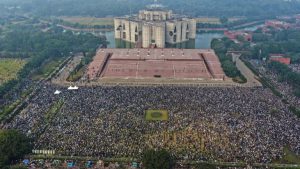
Outside the hospital gates, crowds gathered in silence, offering prayers and tears. Many said they felt compelled to be present, even without the chance to see her. The following day, tens of thousands attended her funeral at Manik Mia Avenue, joined by political leaders, diplomats, and interim government head Muhammad Yunus—an unmistakable sign of how far Khaleda Zia’s influence reached beyond party lines.
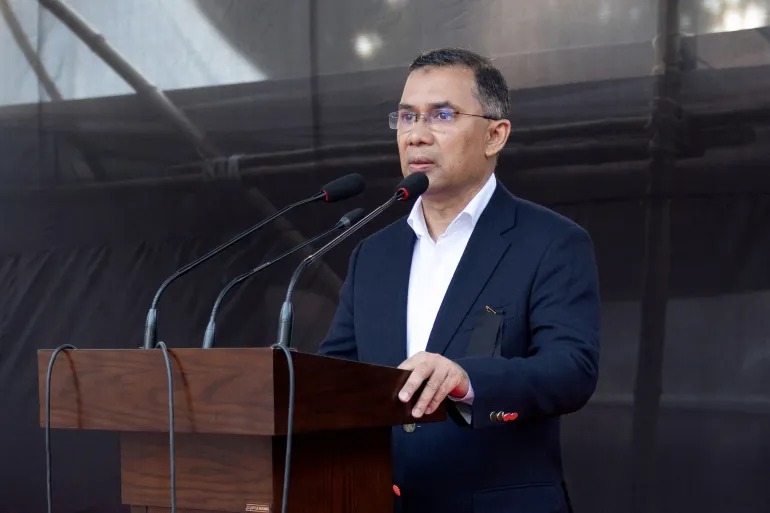
Yet as the nation mourns, the BNP now faces a harder reality. Analysts say her death marks a decisive rupture for the party just weeks before national elections scheduled for February 12. For years, Khaleda Zia’s legacy served as the party’s anchor, maintaining unity even when illness kept her away from active politics. Her absence now places full responsibility on her son and acting party chairperson, Tarique Rahman.
Within the BNP, leaders insist the transition is already underway. Party advisers describe Khaleda Zia as a guardian of parliamentary democracy, rule of law, and civil freedoms, values they say will guide their campaign. They argue that Tarique Rahman has already demonstrated leadership by coordinating protests that reshaped the political order in 2024 and by outlining reform proposals focused on voting rights and institutional accountability.
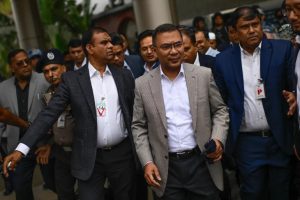
Still, political observers remain cautious. Khaleda Zia’s personal authority, they note, often settled internal disputes and postponed leadership challenges. Without her, Tarique Rahman must now prove himself through action rather than symbolism. The upcoming election, analysts argue, will serve as his first real test—success could cement his leadership, while failure may reopen internal questions.
The political environment itself has also changed. With the Awami League’s activities banned following last year’s upheaval, Bangladesh’s long-standing two-party rivalry has fractured. BNP must now compete in a crowded field that includes a growing Islamist alliance and new parties led by youth figures from the 2024 mass movement. This shift, experts say, has altered the rules of electoral politics entirely.
Uncertainties remain over whether the election will proceed on schedule and whether it can be conducted peacefully. Concerns about discipline within party ranks and allegations against some activists continue to surface, though BNP leaders say internal reforms are planned.
For many supporters, however, politics remains deeply personal. Grassroots activists recall Khaleda Zia not only as a leader, but as part of a political lineage that began with her husband, former president Ziaur Rahman. They now look to Tarique Rahman to carry that inheritance forward.
In the end, BNP’s future will depend on more than memory. Legacy may inspire loyalty, but voters will deliver the final verdict at the ballot box.