
Unrest in Bangladesh intensifies as students and journalists warn of violence, attacks on media, and shrinking democratic space ahead of the 2026 general elections.
By Qalam Times News Network
Dhaka | December 22, 2025
Violence, Unrest political uncertainty, and attacks on press freedom raise alarm ahead of 2026 elections
Unrest is tightening its grip on Bangladesh, with students, journalists, and civil society voices warning that personal safety, democratic norms, and media freedom are under serious threat. Amid growing violence and instability, appeals are mounting for international attention as the country moves toward its next general election scheduled for February 12, 2026.

The Bangladesh Students League (BSL), affiliated with the Awami League, has called on the global community to intervene constructively, stressing that unrest and political disorder are eroding the foundations of constitutional governance. The organization argues that without external pressure, a free, fair, and inclusive election may be impossible under the current circumstances.
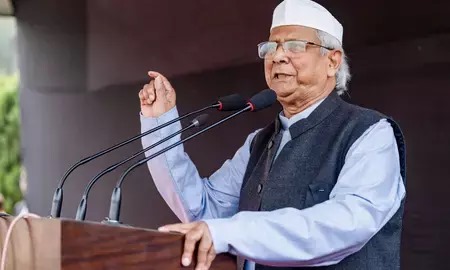
In a strongly worded statement, BSL accused the interim administration led by Muhammad Yunus of presiding over what it described as an unconstitutional system driven by mob rule. According to the student body, the collapse of law and order has fueled extremism, coordinated violence, and a culture of impunity that now defines daily life across the country.
The group pointed to a sharp rise in arson, enforced disappearances, targeted killings, and organized attacks since mid-2024. These incidents, it said, were not random but the result of a deliberate campaign that followed the fall of the elected Awami League government led by Prime Minister Sheikh Hasina. Since then, BSL claims, constitutional rule has steadily given way to fear-driven control exercised through violence.
Condemning recent attacks on major media houses, including Prothom Alo and The Daily Star, the student organization described the arson attempts as direct assaults on press freedom. The attempted burning of The Daily Star office, with journalists trapped inside, was labeled an act that could have resulted in mass casualties. The reported harassment of senior editors further reinforced concerns that independent journalism is being systematically silenced.
BSL also highlighted a brutal killing in the Bhaluka area of Mymensingh, where a Hindu youth, Dipu Chandra Das, was allegedly beaten to death over false blasphemy accusations and his body burned. The organization said the incident exposed a complete failure of due process and represented a grave human rights violation.
In addition, the group expressed alarm over repeated attacks on Indian diplomatic missions in Chittagong, Rajshahi, and Khulna, warning that such actions breach international law and further isolate Bangladesh on the global stage.
Meanwhile, senior editors and journalists have urged the Bangladesh Nationalist Party (BNP) to commit publicly to protecting press freedom if it assumes power. Speaking at a BNP-organized event marking the return of acting chairman Tarique Rahman after 18 years, media leaders emphasized that no previous period in Bangladesh’s 53-year history had seen newsrooms targeted with arson.
The Daily Star editor Mahfuz Anam warned that national institutions are being dismantled, leaving little space for critical voices. He stressed that freedom of speech without room for criticism is meaningless and urged future governments to accept scrutiny as essential to good governance.
Prothom Alo editor Matiur Rahman reflected on past political eras, describing the Awami League’s long tenure as especially restrictive for the media due to legal pressure and intimidation. While noting that the BNP’s earlier rule was relatively less hostile, he cautioned that the current political vacuum poses serious risks and demands humility and responsibility from any party seeking power.