

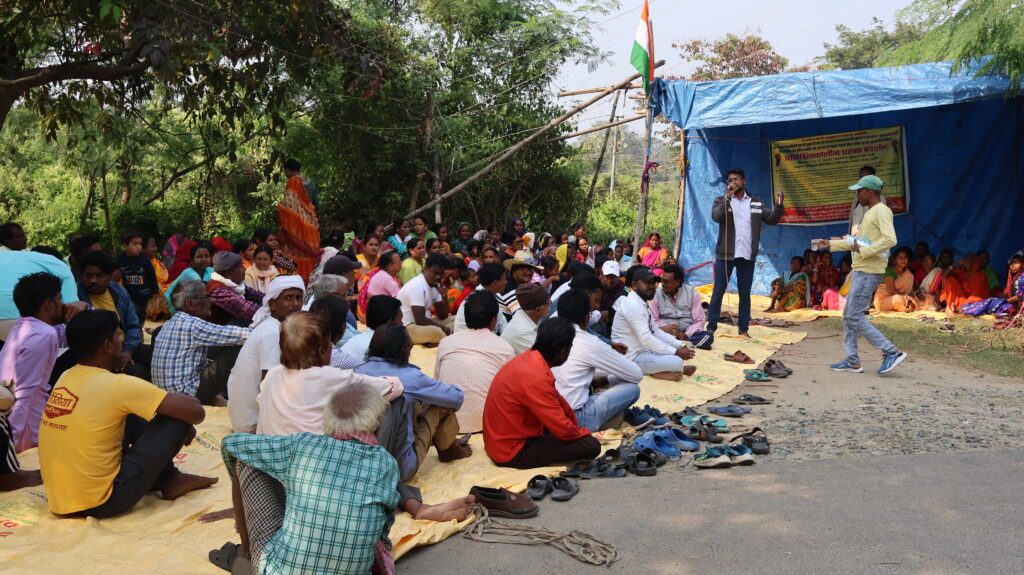
Displacement resurfaces as villagers protest a proposed floating solar power project at Panchet Dam, demanding land rights, compensation, and livelihood protection after decades of neglect.
By Qalam Times News Network
Dhanbad/Purulia | December 15, 2025
Displacement has followed Ram Sahodev Gorai for most of his life, and at nearly 90, it still refuses to loosen its grip. Leaning on a thick wooden stick, Gorai walks slowly through the protest site near the Panchet Dam, his fragile body carrying the weight of a struggle that began more than six decades ago.
Forced from his village when the Panchet Dam submerged large swathes of land in the 1950s, Gorai now finds himself protesting once again—this time against a proposed floating solar power project on the Damodar River. Along with thousands of other displaced families, he fears the new project will erase the last traces of their connection to the land and water they once called home.

The Panchet Dam, built across the Damodar River on the Jharkhand–West Bengal border near Dhanbad, was inaugurated in 1959 under the Damodar Valley Corporation (DVC). Created in 1948 to control floods, generate power, and support irrigation, DVC was modeled on the Tennessee Valley Authority of the United States. But for those who lived along the river, displacement became the unspoken cost of development.
Gorai recalls the night when rising waters swallowed his village. With homes, fields, and documents washed away, survival became the only priority. “We were left with nothing,” he says, his voice trembling. Promises of land, compensation, and jobs never materialised for most families.
According to Mukhtar Ansari, a leading figure in the protest movement, nearly 10,000 families were affected when land was acquired for the Panchet Dam. “People lived in tents. Some drowned. Many were rescued, but rehabilitation never came,” he said. Protests against the injustice began as early as 1968 and have continued in different forms ever since.
Sandhya Gorai, Ram Gorai’s daughter and an anganwadi worker, said her father even worked for DVC after the dam was built. “They promised jobs to displaced families, but barely one percent received employment,” she said. “They became wealthy using our land, while we were pushed into poverty.”
Gorai’s wife, Patu Gorai, now works as a domestic helper to survive. The family lives in an abandoned DVC quarter. “They took everything from us,” she said bitterly. “At this age, we are still struggling.”
Livelihoods Under Threat
The proposed floating solar project has reignited old wounds, especially among fishing communities that depend on the Panchet reservoir. Protesters claim that nearly 1,500 families could lose access to around 1,500 acres of water if the project moves ahead.
The agitation is being led by several tribal and displaced persons’ organisations, including the Damodar Valley Bastuhara Sangram Samiti, Bastuhara Matsyajibi Sangram Samiti, Bharat Jakat Majhi Pargana Mahal, and the Jami Raksha Committee.
Ansari said the situation is even more complex for tribal families whose villages were submerged. “Their documents proving Scheduled Tribe status were destroyed in floods. Now the same state asks them for papers that no longer exist,” he said.
Avinash Tudu, a young protester from a tribal community, travelled long distances to join the demonstration. His family lives on land they do not legally own. “We were allowed to stay temporarily decades ago. Now landowners are asking for money or telling us to leave,” he said, adding that some families are being asked to pay up to ₹2 lakh.
With the Special Intensive Revision of electoral rolls underway, activists fear many displaced people could also lose voting rights due to missing documents.
The Solar Project Plan
According to DVC’s annual reports, approval was granted by the Union Ministry of New and Renewable Energy to develop floating solar parks with a total capacity of 989 MW under the Ultra Mega Renewable Energy Power Parks Scheme.
A joint venture, Green Valley Renewable Energy Limited—49 percent owned by DVC and 51 percent by NTPC Renewable Energy Ltd—is implementing projects at the Tilaiya and Panchet reservoirs. Of the planned 755 MW capacity, contracts for 310 MW under Phase I have already been awarded, including major projects at Panchet.
While DVC says the initiative will help reduce carbon emissions and expand renewable energy, protesters argue that no rehabilitation plan has been communicated to those who stand to lose their livelihoods.
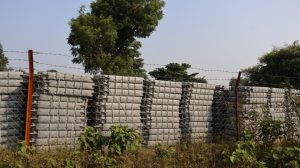
Materials for the solar plant have already arrived near the protest site. “No minister is listening to us,” Sandhya Gorai said. “We are alone, but we will not stop. This land is calling us back.”
A letter sent to the Jharkhand Chief Minister’s office last month remains unanswered.